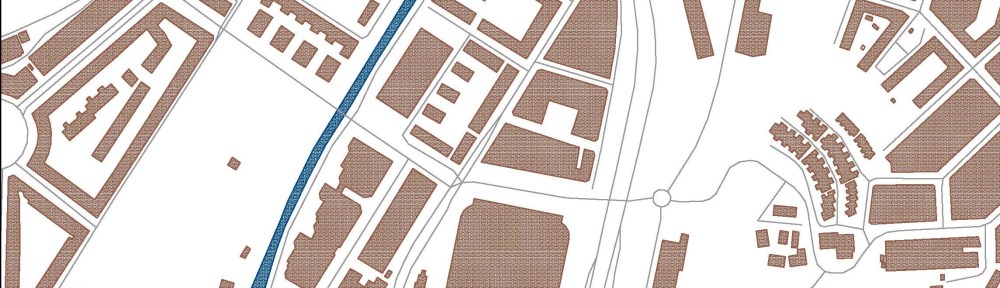
Episodes 103 to 106 take a stroll around North Gårda where the only major decorations are on a tram shed from the 1980s.
Episode 103: kv Vesta, kv Vulkan, kv Diana
District: Gårda
Photo date: 23 December 2020
District Gårda is an industrial estate from the late 1800s, with residential areas in the south. Factories, schools, pollution, children, railway, more factories… and then in the 1960s the eastern half of the district was eradicated when the new motorway was laid out there. Many of the remaining houses were condemned because they were too close to the noisy, polluting and dangerous traffic. Some of the southernmost buildings were saved and even refurbished recently, but most of it has been completely redeveloped. The area looks nothing like old photographs!
The rusty skyscraper called Gårda Vesta was designed by White Arkitekter, still going strong with modern but boring materials. They meant the rust to symbolise the industrial heritage of this district, Gårda. Or perhaps they were just a little bit passé since that particular cladding seems to have fallen out of favour rapidly, after being very in for about five years.
The other blocks in this episode were also modern when they were built, from the 1960s onwards. At Diana, after this video was made a controversial artist was given free reign with a firewall and created a huge vagina mural. Recently, the whole modernist building was torn down and something else will take its place, I guess. Perhaps another skyscraper?
Episode 104: kv Venus, kv Ceres
District: Gårda
Photo date: 23 December 2020
Soon after I started working at Bergab, these modern houses were put up across the river. The foundation works were extensive: it took three combined piles to reach layers that were stiffer than mush! The low-lying area here under the hill to the east is made up of up to 80m or more thick glacial clays, overlain by marine clays and riverine sediments. Marine clays are notoriously tricky: add enough water, give it a little shake, and the solid ground turns into water. Just like ketchup. There’s a scary movie from a Norwegian landslide in thixotropic clays.
The tram museum is great! The depot was built in 1930 and the museum moved in in 1989. Next to it was the old bus garage that was torn down in 2001 to make way for residential houses. The garage was really ugly. At the museum you can not only look at the trams but also rent them. We did this for a science fiction convention some years ago, it was very popular.
Gothenburgers are inveterate punners. All major landmarks get inofficial names like fr’instance Hedendomen for the Catholic church (a pun on ”heathenry” and ”the cathedral next to Heden”). The lamellar house in this block was built for the electricity board in 1960, and was for some reason called Elysépalatset. It was of course immediately renamed El-o-lyse-palatset, ”the electricity and lighting palace”.
Episode 105: kv Merkur
District: Gårda
Photo date: 23 August 2020, 23 December 2020 and 20 March 2021
When every other town and city dismantled their trams in the 1950s and 60s, Gothenburg retained them. Now, every other town and city build new tramways, for some reason. Living in a city where trams have always been part of everyday infrastructure life, it seems much more convenient with buses that can move around obstacles like other vehicles ahead, or downed powerlines. But the trams do have their charm, I guess, and they are a big part of the spirit of Gothenburg.
Tram lines have expanded over the years, and the number of trams too. They all need to be serviced and in the mid-1980s the depot at Stampen was much too small and a new tram shed built across the creek, here at city block Mercury. The architects were Clas Dreijer and Bengt Wallin, working for the ABAKO office. They won the Kasper Salin award in 1985, an award for ”the best building of the year”. In one of my sources, ”Staden, platserna och husen” by Claes Caldenby et al, it says the guy leaning out of a window depicts Domenico Inganni who helped finalise the deocrations. But who were Graham and Åke, whose names are on one of the medallions?
Somewhere on the building there is a plaque commemorating the award but it is not visible from the outer perimeter fence. No trespassing! I mailed them asking for permission to enter and document the cartouches but never got a reply. So I had to stand on the other side of the motorway with the big camera! And again when the building at city block Eagle was finally finished!
Episode 106: kv Fyrkanten, kv Bobinen, kv Dymling
District: Gårda
Photo date: 14 March 2021
Fire stations were put up all over the city in the early 1900s but were then closed again around the 1970s to 80s, when big centralised stations like this one were built. And they no longer house only the fire brigade but all the rescue services. This central rescue services station was put up in 1988, with typical tile decorations on the facade. The architects were FFNS West, whom I had never heard of before because they have turned into Sweco, the big civil engneering company we often do business with.
The 1880s is when textiles became big in Gothenburg. In the marxist 1970s, all the talk was about the proletariat working in the shipyards and how socialism, even communism, was what made Gothenburg if not great then at least remarkable. In fact, the local industry was first based on timber and joinery and then came the textiles. Those workers were the ones who first unionised, but it didn’t take at first, apparently not until the temperance movement had done its thing.
At Åvägen 6 we see the remains of Gårda Fabriker, one of the original textile factories in Gårda. This one made underwear. The current buildings were put up in the early to mid 1900s, designed by Ernst Krüger and Carl Ritzén. Much rebuilding has been going on since the 1990s, and most of the entire area has faced a complete redevelopment from 1965, still ongoing. The Bobbin, for example, was built in 2007. It appears the site held a starch factory that burned down in 1945, and then Semrén+Månsson designed the current buildings.
 Rockyramblings