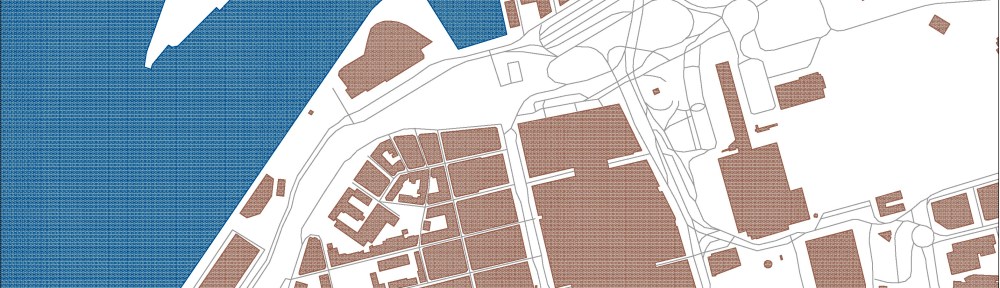
Episodes 22 to 24 mostly contain modern buildings and structures. The city was subject to ”total sanitation” in the 1960s and 1970s, when the politicians and civil servants decreed that old was bad, everything older than 30 years shold be razed and modern concrete boxes be put up instead. The city of my childhood consisted in large parts of demolition sites.
Episode 22: Östra Nordstaden
District: Östra Nordstaden
Photo date: 5 and 18 April 2020
In 1972 this business and shopping precinct was opened. The building work had destroyed every old house except a couple in the extreme southeast corner, and dug up all the archaological remains like the old bastion and sections of moat that once stood here. All gone.
Until 1938, one of the run-down streets held Gothenburg’s only Catholic church, St Joseph. That year, the new church next to Heden was opened. The rest of the area was mostly given over to warehouses, after the emigrant rush was over. Of the ten blocks named in 1923, only five remain today: Hövågen, Klädpressaren, Köpmannen, Drottningtorget and Kronobageriet.
The city before the mid-1960s looks completely different from the city of the mid-noughties. And that city looks completely different from the one today, because of all the skyscrapers that have mushroomed in the last couple of years.
Episode 23: Lilla Bommen, Nya Operan, kv Magasinet, kv Packhuset
District: Östra and Västra Nordstaden
Photo date: 18 April and 27 June 2020
The water-front has been completely transformed several times. In the 1980s, the old warehouses were torn down and our first skyscraper erected instead. Compared to the ones sprouting today, it is quite small… Ralph Erskine designed it for Skanska. Due to its colours, and because it once held offices for the see (”stift”) it was quickly dubbed Läppstiftet (”lipstick”).
Some ten years later, a new opera house was built on the ruins of the old prison, itself built on the ruins of the bastion St Erik. The public could contribute funding and in return got a token signed by the city council at the time. My grandmother sent in some money in the name of her family’s old shop and we still have that piece of paper.
Further along are some remnants of the once bustling harbour. A maritime museum still lines the quay, which is in need of maintenance and climate change security adjustments. And of course, the ”new” customs house has ironically been turned into a casino. (The newest customs office moved to Östra Nordstaden when it was built, along with all the banks.)
Episode 24: broar längs Stora Hamnkanalen
District: Västra and Östra Nordstaden
Photo date: 17 November 2019 to 7 July 2020
The city was originally laid out with the help of Dutch engineers, which meant canals and bridges. All the bridges have been rebuilt at least once and all but one of the canals have been filled in. Before the Lock was built in 1873, there was also a water-mill where the Paupers’ Creek enters the canal system, just inside the old city wall. Until a few years ago, I had no idea about this.
 Rockyramblings