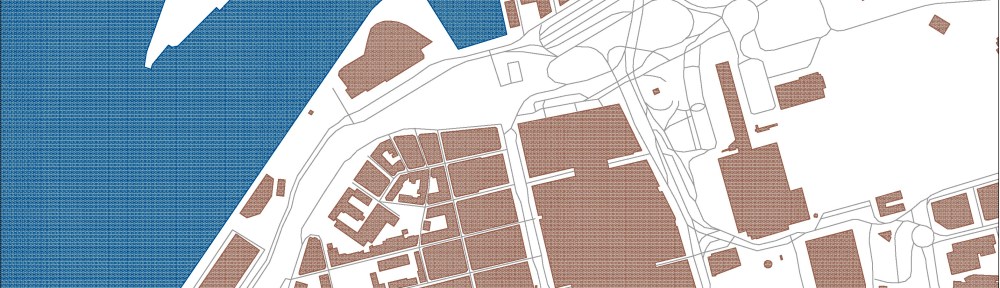
Episodes 6 to 10 continue in the old city. When it was first built, it was surrounded by a high wall with several bastions and an outer moat. The city itself was criss-crossed by Dutch-type canals with bars at the outlets into the river. The walls were torn down in the early 1800s and all but one canal were filled in in the early years of the 20th century.
Episode 6: kv Lilla Bommen
District: Västra Nordstaden
Photo date: 2 January 2020
What do you call the obstacle placed over the outlet of a canal, moat or river? Boom or bar? And don’t confuse this block with the sub-district just north of here, also called Little Boom/Bar.
The main feature in this block is the old Hasselblad headquarters. The camera company expanded until it owned the whole block. They became world famous when they made some of the cameras used in the Apollo program. The brand name still exists but the company itself has been bought and merged a couple of times. When they finally switched to digital they were way behind most of the other camera companies and also made some bad financial decisions. Their fancy new premises on Hisingen were immediately sold and now the Swedish State Television resides there.
This block reflects the company’s various stages of expansion and re-development.
Episode 7: kv Ljusstöparen, kv Mätaren
District: Västra Nordstaden
Photo date: 7 March 2020
The city within the walls was built around two hills, Kvarnberget and Otterhällan. The Mill-hill is the one north of the main canal and in this episode we look at two blocks along its north side.
The Candle-Maker and The Measurer front the St Erik Street, named after one of the old bastions. The area is currently under heavy construction, to make a new subterranean railroad link. The Gothenburg underground is characterised by hard crystalline rock and very thick layers of glacial clay, overlain by marine clays and riverine sediments. No soft rock or hard soil. This makes building work very ”interesting”, geotechnically speaking. The Turkish-Norwegian-Spanish consortium building part of the tunnel has their work cut out for them, trying to understand our sub-soil.
Episode 8: kv Mjölnaren, kv Kvarnberget
District: Västra Nordstaden
Photo date: 8 March 2020
The Mill-hill is quite steep and it has two blocks commemorating the wind-mills that once stood here: Mill-hill and The Miller. Apart from the steepness there isn’t much to tell about these residential buildings.
But underneath the hill it gets more interesting. After the bombing of Guernica, the fire-bombing of London, all German cities and almost all of Japan, and not least the advent of atomic weapons, the city council decided to make civil defence shelters in Kvarnberget and Otterhällan. After the Castle Bravo test in 1954 and the subsequent mad themonuclear arms race, it was felt pointless to build more shelters. But these days, with renewed conventional shelling of city centres, they might come into their own again.
In early geologic investigations for Västlänken, I got to visit the shelter under Kvarnberget in 2012. Awesome! in a chilling sort of way.
Episode 9: kv Navigationsskolan
District: Västra Nordstaden
Photo date: 8 March 2020
On top of Mill-hill is the old School of Navigation, where my father once studied to become a captain in the merchant navy.
The leading men in the city long wanted a school to train boys for a life at sea, but an official school was only opened in the 1840s. The current big building on top of Mill-hill was first built in 1862 and re-developed in 1915. An extension was added in 1952.
In 1994 the school was taken over by the Chalmers University of Technology and moved to new premises on Hisingen. The old building has since housed various civil engineering companies like ÅF (later Afry) and Serneke (current owners).
Episode 10: kv Stadskvarnen
District: Västra Nordstaden
Photo date: 7-8 March 2020
Until the 1970s it was possible to rent cheap accomodation in the old houses in Gothenburg. In this block, The City Mill, we often visited one of my father’s colleagues when I was a kid. It was a very steep climp up the cobbled street, into a courtyard and up rickety stairs to a tiny garret. In the 1970s, much of the city was razed to make way for modern office blocks and housing estates made of concrete. Good-bye cheap garrets!
Ironically, those very concrete housing estate turned out to have been made very shoddily and are now the cheap lodgings decried by the current city planners. Not because they are mouldy and sub-standard but because they are cheap, meaning that they are the only flats immigrants and people on welfare can afford, further meaning that segregation increases and crime erupts. The solution: build new expensive condos and/or refurbish the old flats and raise rents two- to ten-fold, and force the segregated people to move. Or something, I don’t quite follow the reasoning here.
 Rockyramblings